

A nayika, beheld
thinking through dance

Questions on thinking and being cease during perfect action. Perfect action, I have come to believe, is practice: a state of immersion to the point of escape. Where our tendency to equate knowledge production to the mind leaves us mistaken is the flagrant dismissal of the body’s role not only in experience, but also in the active production of knowledge. Nowhere else is this more apparent than in the submission of the body to/through dance.
To converse with the ether through music is a privilege. Among many others who find themselves half-seated, awaiting instruction, I, too, have begun to realise the lightness my body acquires with the tapping of the thattu manai. Often, movement becomes the only way to respond when words remain inadequate. The lightness, funnily enough, is in how grounded we are: a constant reminder to re-centre, sit deeper, and, of course, smile.
Last week, a senior dancer from class, Yadavi Shakdher Menon, performed solo: the first since her Arangetram in 2022. Her seniority is, of course, only in stature; Yadavi is just twenty-two years old—a surprise to all of us who have benefitted from her strict instruction during the lessons she’s stepped in to conduct.
Anukrama: The Next Link fell on a Friday evening wrought with untimely rain. Like many other shades of unpredictability that 2026 has already brought, one would least expect persistent rain in winter. While this did offer immense relief from the otherwise unbreathable New Delhi air, Yadavi’s ode to the art form and the accompanying musicians brought a sense of radiating excitement and calm through the evening, offering a whole other kind of chill down our spines.
Before beginning her performance, Yadavi shared a few words about her relationship with dance as a medium and a method of moving through the world. She asked what most of us wonder: is performance practice, or practice performance? Her commitment to figuring these questions out became clear through every piece of the Margam through the evening. Needless to say, all of them were choreographed by our inimitable Guru, Padmashri Geeta Chandran.
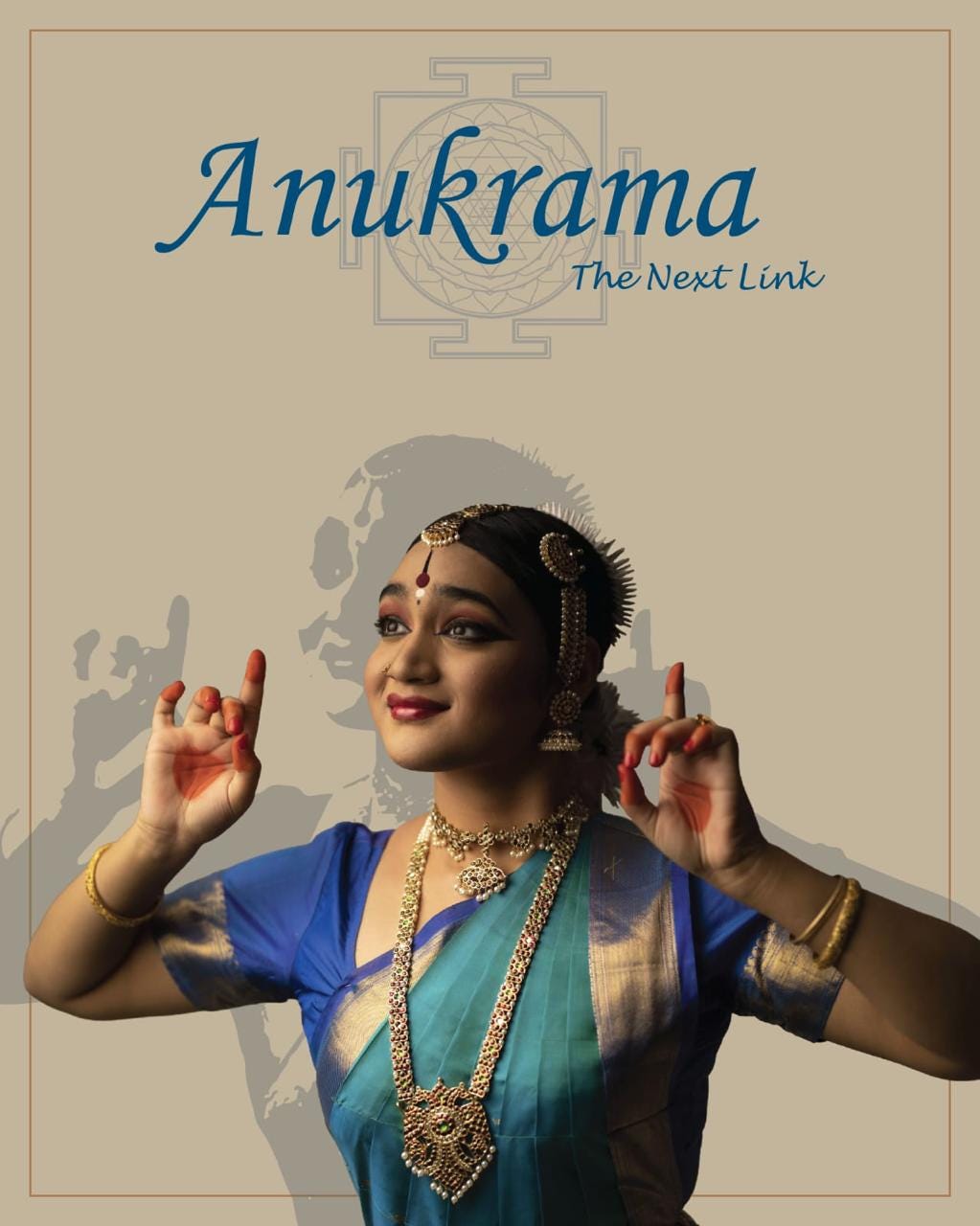
Yadavi began with a Pushpanjali (Ragam Shree, Adi talam), followed by a Shlokam from the Thirumantiram (an ancient Tamil text authored by the mystic saint Thirumoolar). From this moment, her movements were sharp and exact. What she demonstrated from the very beginning was her ability to maintain stasis despite how far she moved from the centre. She came in commanding a sense of respect and awe that grew tenfold by the time she completed her third piece.
Losing no time at all, she moved onto the central piece of the Margam, the Varnam (Ragam Kamboji, Adi talam). The Varnam is a spectacular display of nritta (pure dance) and abhinaya (expression). Like most Varnams on the Nayika, this Varnam was a lamentation to her Sakhi on how she yearns for her Lord, her lover, to present himself.1 Yadavi performed each jati with utmost perfection. Before we could ruminate on the impeccably performed sequence, she moved into the sahityam seamlessly, offering a masterclass in abhinaya for those of us watching.
This continued into possibly my favourite piece from the repertoire that evening. The sequential genius followed up the Varnam with the Ninda Stuti: Ettai Kandu Nee (Ragam Kalyani, Adi talam).2 This piece was of a mother astounded by her daughter’s choice in the very lover she was pining for, asking her what it was about this Lord (here, Lord Shiva) that she found so enticing. Yadavi’s expressions left me in laughter and tears with her demonstration of shock, dismay, and, ultimately, love, that a mother depicts all at once when she knows that her daughter deserves so much more (a feeling we know all too well). As the evening progressed, one might have noticed Yadavi’s confidence growing gradually with every piece as well as a simultaneous bleeding of her personality onto the stage. Following the two pieces above, it felt natural and most organic that she should be there. She belongs nowhere else.
Yadavi then took on an entirely different persona during the Meera Padh: Mane Chakar Rakho, (Ragam Mand, Adi talam, composition of Bhakti poet saint Meerabai). From the yearning of a lover to the love of a devotee, her entire demeanour changed. Her frame acquired a softness and a kind of submission that I have only contemplated while listening to these renditions. As she closed, tears seemed to have welled up in her own eyes—a testament to just how methodically she became the very figure she was performing. To close, as always, was a Tillana (Ragam Yamunakalyani, Adi talam). Yadavi maintained the same sense of enthusiasm with which she had begun the evening. By the end, one could not have noticed the hours that had passed, except that it had stopped raining, and we were all left smiling.
At the very end, Justice Ramsubramanian made an allusion to the Natyashastra: words that I’ve heard Amritha telling us in class and words that I now recite to myself nearly every day. I’ll leave you with that.
‘Yatho Hasta Thatho Drishti
Yatho Drishti Thatho Manah
Yatho Manas Thatho Bhavo
Yatho Bhavo Thatho Rasah’
Where the hands go, the gaze follows
where the gaze goes, the mind follows
where the mind goes, expression follows
where there is expression, there is rapture
This is so beautifully written, Kamya. For somebody who is embarrassingly uneducated about the art form, this made for a very insightful read.